 Tunisia — WC 2026 Group F
Data as of: 2026-05-20





Recent Form
| Date | Opponent | Score | Result | Competition |
|---|---|---|---|---|
| 2025-09-08 | Equatorial Guinea | 1-0 | W | CAF WC 2026 Qualifier — Group H (qualification sealed, Malabo) |
Group F Opponents (2026)
Netherlands
Met once — a 1–0 Netherlands win in the 2022 pre-World Cup friendly window.
Japan
Met in friendlies in the 2010s; no recent competitive crossover between the two federations.
Sweden
Sporadic friendly fixtures across the modern era; the two federations have not met in a competitive WC or qualifying tie.
Key Players for 2026
- Ellyes Skhiri · MF
Eintracht Frankfurt midfielder and captain — the central pillar of Tunisia's structured midfield and the on-field voice through the Lamouchi reset.
- Hannibal Mejbri · MF
Manchester United loanee and the most prominent younger creative in the squad — Lamouchi's most likely No. 10.
- Aymen Dahmen · GK
Goalkeeper who anchored the historic clean-sheet qualifying campaign — Tunisia conceded zero goals across 10 CAF fixtures.
- Aïssa Laïdouni · MF
Ball-winning midfielder whose European club experience underpins the screening role in front of the back four.
- Mohamed Ali Ben Romdhane · MF
Scored the 94th-minute winner in Malabo on 8 September 2025 to seal Tunisia's qualification — the late-runner archetype Lamouchi will lean on.
The Eagles of Carthage arrive at the 2026 FIFA World Cup with the most distinctive qualification résumé in the tournament: zero goals conceded across an entire CAF campaign, the first nation in World Cup history to qualify without giving up a goal. That’s the headline. The subhead is messier — a head-coach change after a 2024 Asian Cup–style domestic upset at AFCON 2025, the Sabri Lamouchi reset, and a Group F draw that pairs Tunisia with one of the most attacking-minded UEFA seeds in the tournament. The opening question of Group F is whether Tunisia can transplant the qualifying defensive system to a tougher level of opposition.
Current Form (Last 12 Months)
The 2026 World Cup qualifying campaign was the most decorated of any African nation. Tunisia finished CAF Group H with 28 points from a possible 30 — nine wins, one draw, no defeats — a goal difference of +22 and, the headline number, zero goals conceded across all 10 fixtures. CAF Online described the campaign as “underlining the side’s solidity and consistency.” The opposition included Namibia, Liberia, Equatorial Guinea, Malawi and São Tomé and Príncipe.
Qualification was sealed on 8 September 2025 with a 1–0 win over hosts Equatorial Guinea in Malabo. Mohamed Ali Ben Romdhane scored in the 94th minute from a Firas Chaouat assist — a fittingly late, fittingly defensive-minded conclusion to a campaign that was about not conceding rather than about overwhelming opponents.
The setback came at AFCON 2025: Tunisia were eliminated in the round of 16 by Mali. Sami Trabelsi — the former Tunisia centre-back who captained the country at the 1998 World Cup and who had led the team through the qualifying campaign — resigned. The Fédération Tunisienne de Football (FTF) appointed Sabri Lamouchi on a 2.5-year deal, with the 2026 World Cup as the immediate target.
The 2026 Squad: Defensive Spine, Selective Spark
The squad’s defining quality is the back-block organisation that delivered the perfect qualifying record. Captain Ellyes Skhiri at Eintracht Frankfurt is the on-field voice through midfield. Goalkeeper Aymen Dahmen anchored the unbeaten-and-clean-sheet campaign. The back-four cohort — including Ali Abdi and Yan Valery — has remained largely settled across the cycle.
The creative axis is younger and less proven. Hannibal Mejbri — the Manchester United loanee — is the most prominent attacking talent of the post-Khazri generation. Aïssa Laïdouni provides the ball-winning profile in front of the defence. Wahbi Khazri, Ferjani Sassi and Naïm Sliti are the experienced figures from the 2018 and 2022 World Cup squads who anchor the locker room.
Most-capped player Radhi Jaïdi (105 caps, the former Bolton Wanderers and Birmingham City centre-back) and record goalscorer Issam Jemâa (36 goals) remain the historical reference points. Foot Africa’s reporting indicated Lamouchi would announce the preliminary squad on 15 May 2026.
Historical Context
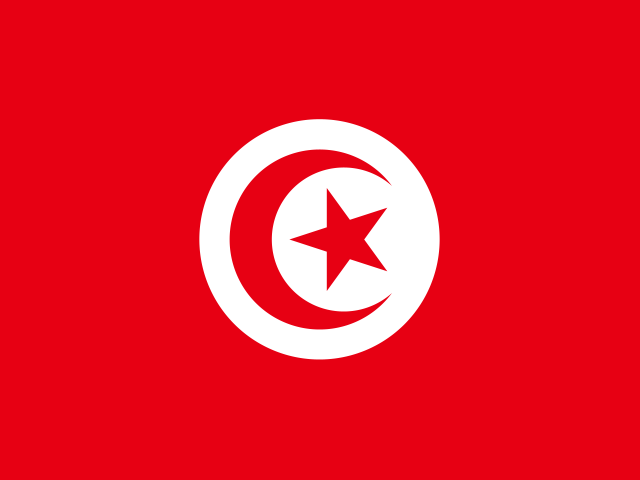
The team is administered by the Fédération Tunisienne de Football (FTF), founded in 1957 in the year following independence from France. Nicknamed the Aigles de Carthage (Eagles of Carthage, in reference to the ancient civilisation centred on modern Tunisia), the team plays in white home shirts and red change kits drawn directly from the white-and-red national flag. The FTF crest features a stylised eagle.
Tunisia’s first FIFA World Cup appearance came at Argentina 1978, when the team defeated Mexico 3–1 in Rosario — making Tunisia the first African and Arab team to win a FIFA World Cup match. The team then drew 0–0 with reigning champions Poland and lost 0–1 to defending champions West Germany in the next two group fixtures. Tunisia did not return to the World Cup until France 1998, but has since been a regular tournament presence: 2002, 2006, 2018, 2022 and now 2026 — one of the longest cumulative World Cup résumés of any African nation. Across all seven previous appearances, Tunisia have yet to advance past the group stage.
The defining continental moment came at the 2004 Africa Cup of Nations, hosted by Tunisia. Coached by Roger Lemerre — formerly France’s Euro 2000-winning manager — and led by playmaker Mehdi Nafti and goalkeeper Ali Boumnijel, Tunisia defeated Morocco 2–1 in the Radès final to win the country’s first and only major continental trophy. Earlier AFCON finals appearances came in 1965 (lost 2–3 to Ghana on home soil) and 1996 (lost 0–2 to South Africa).
Home internationals are played principally at the Hammadi Agrebi Stadium (Stade Olympique de Radès) in Radès, opened in 2001 with a capacity of 60,000 and named in 2022 after Tunisian football administrator Hamadi Agrebi. The 2004 AFCON final was hosted at the same venue. The principal football rivalries are with Algeria (the most-played fixture on the calendar), Morocco (2004 AFCON final), Egypt (AFCON title-deciders) and Libya (regional derby).
Coach Lineage
The modern head-coach lineage includes Mokhtar Tlili, Henryk Kasperczak (multiple spells), Roger Lemerre (2004 AFCON title), Nabil Maâloul, Mondher Kebaier (2022 World Cup), Jalel Kadri, Sami Trabelsi (2026 World Cup qualification — perfect campaign) and Sabri Lamouchi (since 2026). The Trabelsi-to-Lamouchi handover after AFCON 2025 elimination is the most prominent coaching transition of the modern era. Lamouchi previously managed Côte d’Ivoire at the 2014 World Cup as well as Stade Rennais, Nottingham Forest and Cardiff City; his contract runs through 2028 and into the 2027 AFCON cycle.
How Group F Plays Out
The Group F draw — Netherlands (seeded), Japan, Sweden, Tunisia — is the most challenging four-team grouping Tunisia have faced at a World Cup since 2002. Each opponent forces a different shape:
- vs Netherlands — the seeded UEFA side and Euro 2024 semi-finalists. The matchup almost requires Tunisia to play the structured low-block that won qualifying, and to score from a set piece or a single transition.
- vs Japan — the highest-ranked AFC nation and a side that just beat England 1–0 at Wembley. Tunisia’s qualifying defensive shape will be tested by Kaoru Mitoma’s one-v-one threat as much as it will be by Takefusa Kubo’s combinations.
- vs Sweden — Viktor Gyökeres and Alexander Isak form the most dangerous striker pairing in the group. The classic UEFA-vs-CAF physical matchup, and arguably Tunisia’s most winnable game on paper.
The Eagles of Carthage have appeared at seven World Cups (1978, 1998, 2002, 2006, 2018, 2022 and now 2026) and have yet to advance past the group stage. The expanded 48-team format finally provides the historical aperture — third place in a four-team group can still progress as one of the best third-placed sides across the 12 groups, a route that does not previously have existed.
Key Players to Watch
Watch Skhiri’s positioning against the Netherlands’ Frenkie de Jong — if the captain can disrupt the Dutch midfield’s rhythm, Tunisia steal a point. Watch Dahmen’s distribution: Lamouchi has rebuilt the buildup phase around the goalkeeper, and clean second-phase passes against Japan’s high press will define whether the structure holds. Watch Mejbri across all three games — the most likely Tunisia goalscorer when the team has to chase the match. And watch Ben Romdhane’s late runs — the qualifying-decider in Malabo was not a one-off.
Aussie Viewing Windows
Specific kickoff times for Group F’s six matches have not been released by FIFA at the time of publication. Aussie supporters should expect a mix of overnight (early-morning AEST) and afternoon AEST windows depending on the host city assigned to each fixture. We will update this page once the official Group F match schedule is confirmed.
Australia Connection
Australia and Tunisia have met once at a World Cup: the 2022 group-stage fixture in Qatar, with Australia winning 1–0 on 26 November 2022 via Mitchell Duke’s header — a result that helped the Socceroos advance to the round of 16 and remain Tunisia’s most-cited recent World Cup setback. Per Wikipedia’s Socceroos head-to-head archive, the two countries have not met in another senior FIFA-listed fixture.
What Tunisia Need to Advance
Realistically: 4 points and a deep third-place push. A draw with Sweden, a low-scoring loss to the Netherlands, and a result against Japan in the final matchday gives Tunisia the best historical shot at the round of 32. The path to the knockouts runs through transplanting the qualifying defensive system to a higher level of opposition — the principal unfinished target in Tunisian football, given seven previous group-stage exits across nearly five decades.
The bigger picture: this is the first Tunisia World Cup squad with a goalkeeper, a captain and a coach all aligned around defensive structure as the explicit identity rather than an emergent quality. Lamouchi’s contract extends through 2028 and into the 2027 AFCON cycle. The 2026 tournament is the principal sporting target; the trajectory of Tunisian football for the rest of the decade rides on whether the Eagles of Carthage can reach the round of 32 for the first time.
More Reading
All-time history: See Tunisia's full World Cup history (all tournaments) →
 Best Betting Sites
 Best Online Casinos
 Blackjack Sites
 Online Pokies
 Fast Payout Casinos
 PayID Casinos
 New Casinos 2026