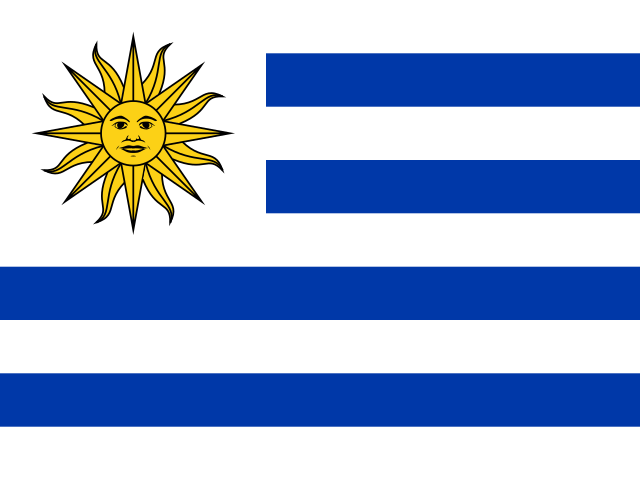
 Uruguay at the World Cup — Full History
Key Facts
- The Asociación Uruguaya de Fútbol (AUF) was founded on 30 March 1900 by four Montevideo clubs — Albion FC, Central Uruguay Railway Cricket Club (CURCC), Deutscher Fussball Klub and Uruguay Athletic Club — making it one of the oldest football associations in South America.
- Uruguay has won the FIFA World Cup twice — 1930 (4–2 vs Argentina at the Estadio Centenario in Montevideo, the inaugural tournament) and 1950 (2–1 vs Brazil at the Maracanã in Rio de Janeiro, the match known in Brazilian historiography as the Maracanazo).
- Uruguay’s 15 Copa América titles are joint-most with Argentina (most recent triumph: 2011 in Argentina).
- The Estadio Centenario, the team’s home ground, was built in 1929–1930 specifically for the 1930 World Cup; on 18 July 1983 FIFA designated it the first and only Historical Monument of World Football.
- Uruguay played its first international on 20 July 1902, losing 0–6 to Argentina in Montevideo — a defeat that began the long-running Clásico del Río de la Plata rivalry.
- Marcelo Bielsa, the Argentine coach previously of Argentina, Chile, Athletic Bilbao, Marseille, Lille and Leeds United, was appointed Uruguay head coach in May 2023.
- Uruguay finished 4th in the CONMEBOL 2026 World Cup qualifying round-robin with 28 points (W7-D7-L4), securing direct qualification ahead of the seventh-place play-off slot.
- At the 2026 FIFA World Cup, Uruguay was drawn into Group H alongside Spain, Cape Verde and Saudi Arabia.
- Diego Godín holds the team caps record at 161 appearances; Luis Suárez is the all-time leading scorer with 69 international goals, having surpassed Edinson Cavani’s record.
- Uruguay’s national colour, sky blue, was adopted in 1910 and the team’s nickname La Celeste derives directly from the kit.
- The nation’s two World Cup titles (1930, 1950) per population — Uruguay had roughly 2.0 million people in 1930 — remains the most-cited statistical anomaly in international football history.
- Uruguay is ranked 17th in the FIFA Men’s Ranking as of April 2026; under Bielsa the team beat both Brazil and Argentina during the 2026 qualifying cycle.
Uruguay World Cup Vital Statistics
| Metric | Value |
|---|---|
| AUF founded | 30 March 1900 |
| First international | 20 July 1902 vs Argentina (lost 0–6, Montevideo) |
| FIFA World Cups won | 2 (1930, 1950) |
| Copa América titles | 15 (most recent 2011) |
| 2026 World Cup qualifying finish | 4th in CONMEBOL, 28 points |
| 2026 World Cup group | Group H — vs Spain, Cape Verde, Saudi Arabia |
| Most caps | Diego Godín (161) |
| Top scorer | Luis Suárez (69) |
| Largest win | 9–0 vs Bolivia (Lima) |
| Heaviest defeat | 0–6 vs Argentina |
| Current head coach | Marcelo Bielsa (since May 2023) |
| Captain | José María Giménez |
| FIFA Men’s Ranking | 17th |
| Confederation | CONMEBOL |
| Kit supplier | Nike (since 2024) |
Uruguay at the World Cup — History And Profile
The Uruguay national football team — La Celeste — is one of the most historically influential sides in football. Despite a population of roughly 3.4 million, Uruguay has won two FIFA World Cups (1930 and 1950) and 15 Copa América titles, the latter joint-most in the competition’s history alongside Argentina. The team is administered by the Asociación Uruguaya de Fútbol (AUF), which was founded on 30 March 1900 by four Montevideo clubs — Albion FC, the Central Uruguay Railway Cricket Club (CURCC), the Deutscher Fussball Klub and the Uruguay Athletic Club — and which helped establish CONMEBOL in 1916. Uruguay’s first official international was a 0–6 defeat to Argentina on 20 July 1902 in Montevideo, the start of the Clásico del Río de la Plata.
Uruguay hosted and won the inaugural FIFA World Cup in 1930. The Estadio Centenario in Montevideo — designed by architect Juan Antonio Scasso, built between 21 July 1929 and July 1930 — was completed in time to host the final, where Uruguay defeated Argentina 4–2 with goals from Pablo Dorado, Pedro Cea, Santos Iriarte and Héctor Castro. The stadium was declared the first and only FIFA Historical Monument of World Football on 18 July 1983 and remains the most-used Uruguay home ground.
Uruguay’s second World Cup title came twenty years later in Brazil. After the 1934 and 1938 boycotts, Uruguay returned to the tournament in 1950 and reached the deciding final round, in which they were required to defeat hosts Brazil at the Maracanã. With Brazil needing only a draw to win the title, Uruguay won 2–1 on 16 July 1950 — a result remembered in Brazil as the Maracanazo and immortalised by captain Obdulio Varela’s pre-match leadership and the goals of Juan Alberto Schiaffino and Alcides Ghiggia. The official attendance is variously cited at between 173,850 and 199,854.
Beyond the World Cup, Uruguay has dominated the Copa América with 15 titles (1916, 1917, 1920, 1923, 1924, 1926, 1935, 1942, 1956, 1959 [Ecuador], 1967, 1983, 1987, 1995, 2011), with the 2011 win in Argentina the team’s most recent senior trophy. Uruguay also won Olympic football gold in 1924 and 1928 — wins which FIFA’s official magazine and historians retrospectively cite as professional football’s first true world championships.
The 21st-century era has been dominated by the so-called “Maestro generation” coached by Óscar Tabárez (in two stints, 2006–2021) and led by Diego Forlán (Golden Ball winner at the 2010 World Cup), Diego Godín, Luis Suárez and Edinson Cavani. Uruguay reached the 2010 World Cup semi-finals — beating Ghana on penalties in the quarter-final after a Suárez handball on the line — and won the 2011 Copa América. The post-Tabárez transition saw Diego Alonso take over for the 2022 World Cup (group-stage exit), followed by the appointment of Marcelo Bielsa in May 2023. Bielsa — the Argentine coach with prior senior posts at Argentina, Chile, Athletic Bilbao, Marseille, Lille and Leeds United — has overseen wins over both Brazil and Argentina during the 2026 qualifying cycle and a 4th-placed CONMEBOL finish on 28 points (level with Colombia, Brazil and Paraguay; ahead on goal difference and head-to-head).
The 2026 squad represents the team’s first World Cup without Suárez and Cavani, both of whom have retired internationally. Captain José María Giménez (Atlético Madrid) anchors the defence; Federico Valverde (Real Madrid), Manuel Ugarte (Manchester United) and Rodrigo Bentancur (Tottenham) form the midfield spine; and Darwin Núñez (Al-Hilal, Saudi Arabia) leads the attack alongside Maximiliano Araújo, Facundo Pellistri and Brian Rodríguez. Uruguay was drawn into Group H of the 2026 finals alongside Spain, Cape Verde and Saudi Arabia.
The team’s principal rivalries are with Argentina (the Clásico del Río de la Plata, contested over more than 200 senior fixtures since 1902) and Brazil (the 1950 final and recurring Copa América and qualifying meetings). Uruguay’s deep institutional connection to football — the country’s literary, journalistic and political life have all been entwined with the AUF and clubs Peñarol and Nacional — is reflected in the AUF Football Museum at the Estadio Centenario. Nike replaced Puma as kit supplier in 2024 under a multi-year agreement.
Uruguay enters the 2026 World Cup as a contender to advance from the group stage and a possible quarter-final dark horse, with form against South American superpowers under Bielsa supporting the medium-term outlook. The Asociación Uruguaya de Fútbol (auf.org.uy) confirms the Selección Mayor brand and the active 2026 qualifying record, while FIFA’s CONMEBOL standings page confirms Uruguay’s 4th-placed finish on 28 points across the 18-match round-robin, level with Colombia, Brazil and Paraguay but separated on goal difference and head-to-head tiebreakers.
Detailed Profile
Crest, Colours & Kit Evolution
The current sky-blue home shirt was adopted in 1910 to commemorate Uruguay’s win over Argentina earlier that year — the colour took inspiration from the kit of River Plate de Montevideo, the Uruguayan side that beat the Argentine River Plate at that time. The four stars above the AUF crest commemorate the 1924 and 1928 Olympic golds (which FIFA recognises as world-championship equivalents) and the 1930 and 1950 World Cup titles. Nike took over kit supply from Puma in 2024.
Stadium & Venue History
The Estadio Centenario in Montevideo (capacity approximately 60,000 in current configuration) has been Uruguay’s national-team home since the 1930 World Cup. Built between July 1929 and July 1930 to a Juan Antonio Scasso design, it hosted the inaugural World Cup final and remains the only FIFA-designated Historical Monument of World Football (1983). The stadium also houses the AUF’s football museum. Other regular Uruguay venues include the Estadio Gran Parque Central (Nacional, Montevideo) and the Campeón del Siglo (Peñarol, Montevideo).
Coaches & Managers Legacy
- Pre-1990: Alberto Suppici (1930 World Cup champion), Juan López Fontana (1950 World Cup champion), Ondino Viera, Juan Hohberg.
- 1990s–2000s: Ángel Cappa, Daniel Passarella (Argentine, brief spell), Víctor Púa, Jorge Fossati.
- 2006–2021: Óscar Washington Tabárez (longest-serving coach with two spells; 2010 semi-final, 2011 Copa América).
- 2022: Diego Alonso (2022 World Cup, group-stage exit).
- 2023–present: Marcelo Bielsa (Argentine; appointed May 2023).
Iconic Players (long-serving / influential)
- 1920s–1930s: José Nasazzi (1930 World Cup-winning captain, “El Mariscal”), Pedro Cea, Héctor Scarone, Héctor Castro.
- 1950: Obdulio Varela (1950 captain, “El Negro Jefe”), Juan Alberto Schiaffino, Alcides Ghiggia.
- 1960s–1980s: Pedro Rocha, Ladislao Mazurkiewicz, Enzo Francescoli (“El Príncipe”), Rubén Sosa.
- Modern era (2006–): Diego Forlán (2010 World Cup Golden Ball), Diego Lugano, Diego Godín (161 caps record), Luis Suárez (69 goals — top scorer), Edinson Cavani, Fernando Muslera.
- Current squad: José María Giménez (captain), Federico Valverde, Manuel Ugarte, Rodrigo Bentancur, Darwin Núñez, Facundo Pellistri.
Trophies & Honours
- FIFA World Cup: champions 1930, 1950.
- Copa América: 15 titles (1916, 1917, 1920, 1923, 1924, 1926, 1935, 1942, 1956, 1959, 1967, 1983, 1987, 1995, 2011).
- Olympic gold (men’s): 1924, 1928.
- Mundialito (1980, contested in Montevideo to mark the 50th anniversary of the 1930 World Cup): champion (vs Brazil 2–1).
- Pan American Games: multiple titles.
Peak Eras
- 1924–1930: Olympic golds and inaugural World Cup, “professional football’s first dynasty.”
- 1950–1956: Second World Cup title plus Copa América wins.
- 2006–2021: Tabárez era — 2010 World Cup semi-final, 2011 Copa América and stable qualification cycles.
Rivalries
- Argentina (Clásico del Río de la Plata): the world’s longest-running international rivalry, contested since 20 July 1902.
- Brazil: the 1950 World Cup final (Maracanazo) and recurring Copa América/World Cup-qualifying encounters.
- Australia: post-2001 series of qualifying play-offs (see Australia Connection below).
Public Image — Bad PR / Controversies
- Luis Suárez bites: three on-field biting incidents at club level (2010, 2013) and at the 2014 World Cup against Italy’s Giorgio Chiellini, the latter resulting in a four-month FIFA suspension.
- 2010 World Cup quarter-final: Suárez handball on the line against Ghana, followed by Asamoah Gyan’s missed penalty and Uruguay’s eventual penalty-shoot-out win, prompting wide ethical debate.
- AUF governance: 2017 FIFA-imposed normalisation committee following internal AUF dispute.
Australia Connection
Uruguay and Australia have an extensive World Cup play-off history. The two sides met in the CONMEBOL–OFC inter-confederation play-offs for the 2002 and 2006 World Cups. In November 2001 Uruguay won 3–0 in Montevideo to reach Korea/Japan 2002. In November 2005, the return play-off ended in a 1–0 win to Australia in Sydney (Mark Bresciano), levelling the aggregate; after extra time the tie went to penalties, in which Mark Schwarzer saved twice and John Aloisi scored the decisive kick to send Australia to the 2006 World Cup — Australia’s first qualification in 32 years and the most-cited match in the modern history of Australian football. The two sides also met in friendlies in 1971 and 1974.
Connections to Other Sports / Wider Football
The AUF also runs Uruguay’s women’s, U-23, U-20, U-17 and futsal national programmes. Uruguay’s Sub-20 (U-20) team won the 2023 FIFA U-20 World Cup in Argentina under coach Marcelo Broli. The senior squad is overwhelmingly drawn from European clubs (La Liga, Premier League, Serie A) plus Saudi Pro League imports, with the domestic Primera División still feeding youth pathways.
Potential Future Trajectory
Uruguay enters the 2026 FIFA World Cup as a credible knock-out contender. With Marcelo Bielsa under contract through the 2026 cycle and a young attacking spine of Darwin Núñez, Federico Valverde, Manuel Ugarte and Rodrigo Bentancur, the team has more depth than at the 2022 World Cup. Beyond 2026, succession at centre-back from José María Giménez and the post-Suárez/Cavani forward line will be the medium-term focus. Uruguay is also part of the joint 2030 World Cup hosting agreement, with the 1930 anniversary opening match scheduled for the Estadio Centenario in Montevideo.
More World Cup 2026 Reading
WC 2026 context: See Uruguay's WC 2026 group-stage form, squad and opponents →
 Best Betting Sites
 Best Online Casinos
 Blackjack Sites
 Online Pokies
 Fast Payout Casinos
 PayID Casinos
 New Casinos 2026