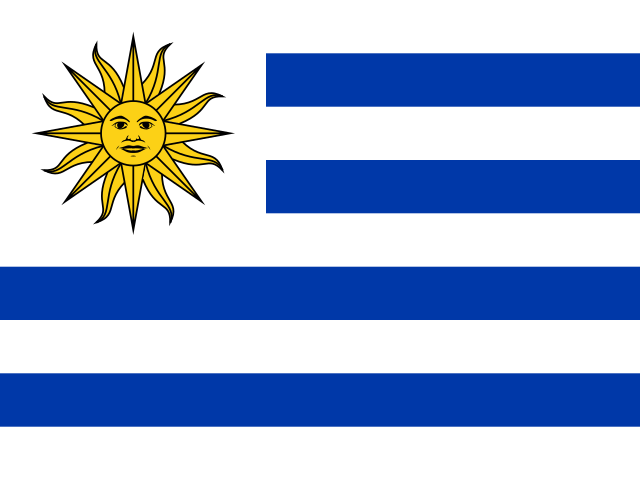
 Uruguay — WC 2026 Group H
Data as of: 2026-05-20





Group H Opponents (2026)
Spain
Two world champions in the same group — Uruguay (1930, 1950) and Spain (2010). Likely to decide first place in Group H and the round-of-32 seeding.
Saudi Arabia
Bielsa's vertical-pressing Uruguay is the kind of South American profile Saudi Arabia have historically struggled against; the likely 2nd-place decider for both sides.
Cape Verde
First competitive meeting. Uruguay's task is to break a compact CAF-qualifier-tested mid-block — set-pieces and Cape Verde's aerial defending will define the scoreline.
Key Players for 2026
- Federico Valverde · MF
Real Madrid box-to-box midfielder — the engine of Bielsa's vertical-pressing system and Uruguay's most reliable late-arriving goal threat.
- Darwin Núñez · FW
Al-Hilal centre-forward; the post-Cavani lead striker whose pace and physical profile is the most direct attacking outlet in the squad.
- José María Giménez · DF
Atlético Madrid captain, the spine of the defence and the carrier of Diego Godín's institutional standards in a post-Maestro-generation squad.
- Manuel Ugarte · MF
Manchester United defensive midfielder; Bielsa's ball-winner and the deep-press trigger Uruguay built around in the qualifying cycle.
- Ronald Araújo · DF
Barcelona centre-back when fit — aerially dominant and quick across the ground; the most-improved partnership next to Giménez in 2026.
Uruguay — La Celeste — arrive at the 2026 FIFA World Cup as one of the most institutionally credentialled small nations in the sport. Two-time World Cup champions (1930, 1950), 15-time Copa América winners (joint-most with Argentina), and the only country whose national stadium has been declared a FIFA Historical Monument of World Football. The 2026 cycle is also the first World Cup without Luis Suárez or Edinson Cavani in the senior squad — a generational transition Marcelo Bielsa was appointed in May 2023 to manage. Group H — Spain, Saudi Arabia, Cape Verde — is the kind of draw a Bielsa side can navigate to a deep round-of-32 placement.
A Federation Built on Two World Cups and 15 Copa Américas
Uruguay hosted and won the inaugural FIFA World Cup in 1930. The Estadio Centenario in Montevideo — designed by architect Juan Antonio Scasso, built between July 1929 and July 1930 — was completed in time to host the final, where Uruguay defeated Argentina 4-2 with goals from Pablo Dorado, Pedro Cea, Santos Iriarte and Héctor Castro. The stadium was declared the first and only FIFA Historical Monument of World Football on 18 July 1983 and remains the most-used Uruguay home ground.
Uruguay’s second World Cup title came twenty years later in Brazil. After the 1934 and 1938 boycotts, Uruguay returned in 1950 and reached the deciding final round, in which they were required to defeat hosts Brazil at the Maracanã. With Brazil needing only a draw to win the title, Uruguay won 2-1 on 16 July 1950 — a result remembered in Brazil as the Maracanazo and immortalised by captain Obdulio Varela’s pre-match leadership and the goals of Juan Alberto Schiaffino and Alcides Ghiggia. The official attendance is variously cited at between 173,850 and 199,854.
Beyond the World Cup, Uruguay has dominated the Copa América with 15 titles, with the 2011 win in Argentina the team’s most recent senior trophy. Uruguay also won Olympic football gold in 1924 and 1928 — wins which FIFA’s official magazine and historians retrospectively cite as professional football’s first true world championships. The four stars above the AUF crest commemorate the two Olympic golds and the two World Cup titles. Sky blue has been the national colour since 1910; the nickname La Celeste derives directly from the kit.
Honours at a Glance
- FIFA World Cup: champions 1930, 1950.
- Copa América: 15 titles (1916, 1917, 1920, 1923, 1924, 1926, 1935, 1942, 1956, 1959, 1967, 1983, 1987, 1995, 2011) — joint-most with Argentina.
- Olympic gold (men’s): 1924, 1928.
- Mundialito (1980): champions, defeating Brazil 2-1 in Montevideo.
- Pan American Games: multiple titles.
The all-time top scorer is Luis Suárez (69 goals, retired internationally after the 2024 cycle). The most-capped player is Diego Godín (161 caps). The Asociación Uruguaya de Fútbol was founded on 30 March 1900 by four Montevideo clubs — Albion FC, the Central Uruguay Railway Cricket Club (CURCC), the Deutscher Fussball Klub and the Uruguay Athletic Club — making it one of the oldest football associations in South America. The first international was a 0-6 defeat to Argentina on 20 July 1902 in Montevideo, the start of the Clásico del Río de la Plata.
Current Form (Last 12 Months)
The CONMEBOL 2026 qualifying round-robin produced one of Uruguay’s best campaigns of the modern era. Bielsa’s side finished 4th with 28 points across the 18-match cycle (seven wins, seven draws, four losses) — level with Colombia, Brazil and Paraguay on points but separated by goal difference and head-to-head tiebreakers. The campaign included wins over both Brazil and Argentina, a feat Uruguay had not achieved in a single qualifying cycle since the 2006-2010 transition under Óscar Tabárez.
The Bielsa appointment in May 2023 was the federation’s biggest single decision since Tabárez’s first tenure ended in 2021. The Argentine — previously head coach of Argentina, Chile, Athletic Bilbao, Marseille, Lille and Leeds United — brought a system built on relentless pressing, vertical passing and total commitment from every player on the pitch. The qualifying numbers say it has worked. The post-Tabárez transition’s first attempt under Diego Alonso ended in a group-stage exit at the 2022 Qatar World Cup; Bielsa has reset the technical baseline in two and a half years.
By April 2026 Uruguay sat 17th in the FIFA Men’s Ranking — comfortable group-stage qualifier territory and a credible round-of-16 contender. The senior squad has more depth than at the 2022 World Cup, with the European-club spine of Valverde (Real Madrid), Ugarte (Manchester United) and Bentancur (Tottenham) anchoring the midfield.
The 21st-century Uruguay story is essentially two eras: the “Maestro generation” under Óscar Washington Tabárez (in two stints, 2006–2021) and the Bielsa reset that followed Diego Alonso’s brief 2022 tenure. Tabárez led Uruguay to the 2010 World Cup semi-finals — beating Ghana on penalties in the quarter-final after a Luis Suárez handball on the line and Asamoah Gyan’s missed penalty — and to the 2011 Copa América title. Diego Forlán won the 2010 World Cup Golden Ball. Diego Godín (161 caps — record) anchored the back four for over a decade. Luis Suárez retired as the all-time leading scorer with 69 international goals, having surpassed Cavani.
The 2026 Squad: Post-Suárez Transition
The 2026 squad is the first Uruguay World Cup roster without Suárez or Cavani — both retired internationally — and the first with a younger frontline as the headline attacking pool. Captain José María Giménez (Atlético Madrid) anchors the defence; Federico Valverde (Real Madrid), Manuel Ugarte (Manchester United) and Rodrigo Bentancur (Tottenham) form the midfield spine; and Darwin Núñez (Al-Hilal) leads the attack alongside Maximiliano Araújo, Facundo Pellistri and Brian Rodríguez.
Ronald Araújo (Barcelona), when fit, is one of the finest centre-backs in world football — aerially dominant, quick across the ground, composed under pressure. The depth extends to Giorgian de Arrascaeta, who can change a match from the bench, and the goalkeeper Sergio Rochet who has succeeded Fernando Muslera as first-choice. The squad’s European-club share is overwhelming; the domestic Primera División still feeds youth pathways but the senior squad is overwhelmingly drawn from La Liga, Premier League, Serie A and Saudi Pro League rosters.
The challenge is consistency. Uruguay’s 2022 World Cup campaign — curtailed at the group stage despite wins over Ghana and South Korea — proved that quality alone does not guarantee progress. Bielsa’s teams are physically demanding, and managing player workload across a 48-team tournament’s expanded schedule will test the squad’s fitness.
How Group H Plays Out
Group H is the tournament’s headline group. Spain are joint pre-tournament favourites; Uruguay are the deep-stage contenders; Saudi Arabia and Cape Verde fight for the best-third-placed lifeline. Uruguay’s most likely path is second place — a finish that secures round-of-32 qualification and a meaningful seeding outcome.
- vs Spain. The headline fixture of Group H — two World Cup champions in the same group, almost certainly playing for top spot. Uruguay’s vertical-pressing system is the rare profile that can disrupt Spain’s possession rhythm if executed at intensity. Bielsa-vs-de la Fuente is the most stylistically interesting matchup in the group.
- vs Saudi Arabia. The likely second-place decider. Saudi Arabia have no head coach at the time of the May 2026 cut following Hervé Renard’s 17 April sacking; Uruguay’s structural quality should be the difference. The risk is exactly the Qatar 2022 Argentina-trap: a tight first 60 minutes, a late lapse, and a result that doesn’t read like the form guide.
- vs Cape Verde. First competitive meeting. The Blue Sharks’ compact mid-block is the structural challenge — but Uruguay’s set-piece threat (Giménez, Núñez, Araújo) is the highest in the group, and the goal-difference column matters.
Win against Saudi Arabia and Cape Verde with a draw against Spain, and Uruguay finish on 7 points and almost certainly second in the group. Even 6 points likely advances them. The 48-team format’s longer rest windows reward squad depth, and Bielsa’s rotation patterns through qualifying suggest he plans to use that.
Key Players to Watch
Watch Valverde’s late runs into the box — Uruguay’s most reliable secondary goal threat and the player most likely to settle the Spain fixture. Watch Núñez’s pace against the Spain high line; the most stylistically asymmetric matchup in the group and one of the few ways to beat that defensive shape. Watch Ugarte against Rodri — the pressing-trigger duel that decides the midfield tempo. Watch Giménez at set-pieces, both ends. And watch Araújo’s fitness reports through the tournament window; Uruguay’s defensive ceiling depends heavily on him being available.
What Uruguay Need to Advance
Realistically: 7 points and second place. Two wins against Saudi Arabia and Cape Verde plus a competitive showing against Spain almost certainly advances Uruguay as group runners-up. The path to the round of 16 from there depends on which third-placed side completes the round-of-32 bracket — but Uruguay’s track record under Bielsa, the European-club depth of the squad, and the post-2022 institutional reset all point to a credible quarter-final ceiling.
The bigger picture: this is a transitional Uruguay squad, but it’s a transition done well. Bielsa’s contract runs through the 2026 cycle, and Uruguay are also part of the joint 2030 World Cup hosting agreement, with the 1930-anniversary opening match scheduled for the Estadio Centenario in Montevideo. The next generation — Valverde, Núñez, Pellistri, Logan-Costa-tier defenders — is in place; the 2026 World Cup is the proving ground.
Rivalries and Coaching Lineage
Uruguay’s principal rivalries are with Argentina (the Clásico del Río de la Plata, contested over more than 200 senior fixtures since 1902) and Brazil (the 1950 final and recurring Copa América and qualifying meetings). The Australia play-off history is the third strand — Sydney 2005 a foundational match in modern Australian football history, detailed below in the Aussie Viewing section. Under Bielsa the 2026 qualifying cycle produced wins over both Brazil and Argentina, a single-cycle achievement Uruguay had not produced since the 2006–2010 transition.
The coaching lineage tells its own story. Alberto Suppici won the 1930 World Cup. Juan López Fontana won the 1950 World Cup. Óscar Washington Tabárez — the “Maestro” — served two stints (1988-1990 and 2006-2021) and led the 2010 World Cup semi-final and 2011 Copa América campaigns; his second tenure remains the longest in modern Uruguay coaching history. Diego Alonso’s brief 2022 spell ended at the group stage in Qatar. Marcelo Bielsa, the Argentine appointed in May 2023, is the third successive coach the federation has charged with a 2026-focused rebuild — and the first since Tabárez to win consecutive cycle-defining matches.
The squad’s two darker historical moments — Luis Suárez’s three on-field biting incidents (2010, 2013, and the 2014 World Cup against Italy’s Giorgio Chiellini, the latter resulting in a four-month FIFA suspension), and the 2010 World Cup quarter-final handball against Ghana that opened wide ethical debate — are part of the modern Uruguay football identity. The 2017 FIFA-imposed normalisation committee after an internal AUF dispute is the most recent governance flashpoint; the federation has run on a stable footing since.
Estadio Centenario and the 2030 Anniversary Cycle
The Estadio Centenario in Montevideo — current capacity approximately 60,000 — has been Uruguay’s national-team home since the 1930 World Cup. It hosted the inaugural World Cup final and remains the only FIFA-designated Historical Monument of World Football. The stadium also houses the AUF’s football museum. Other regular Uruguay venues include the Estadio Gran Parque Central (Nacional, Montevideo) and the Campeón del Siglo (Peñarol, Montevideo). Nike replaced Puma as kit supplier in 2024 under a multi-year agreement; the current sky-blue home shirt was adopted in 1910 to commemorate Uruguay’s win over Argentina earlier that year.
Beyond 2026, the 2030 FIFA World Cup hosting agreement gives Uruguay a unique strategic horizon. Uruguay is part of the joint 2030 hosting consortium (with Argentina, Paraguay, Spain, Portugal and Morocco under the centenary format), and the 1930-anniversary opening match is scheduled for the Estadio Centenario in Montevideo — exactly one century after the venue hosted the inaugural World Cup final. The 2026 World Cup performance becomes the public-facing setup for that anniversary moment.
Aussie Viewing
Uruguay and Australia share one of the most emotionally loaded shared histories in world football. The November 2001 World Cup play-off (Uruguay won 3-0 in Montevideo) sent the Socceroos crashing out of the 2002 World Cup; the November 2005 return play-off in Sydney — a 1-0 Australia win on the night (Mark Bresciano), then a penalty shoot-out in which Mark Schwarzer saved twice and John Aloisi scored the decisive kick — sent Australia to the 2006 World Cup, their first qualification in 32 years and the single most-cited match in the modern history of Australian football. The two sides also met in friendlies in 1971 and 1974, and the 2005 shoot-out remains the foundational match in modern Australian football consciousness.
Any Uruguay-related WC 2026 viewing for Australians carries that residue, twenty years on from the Sydney night. The full Australia-Uruguay history is the most-cited cross-border narrative on AF and lives on at the Australia-Uruguay rivalry hub. All Group H kickoff times and AEST conversions will publish in the WC 2026 schedule in AEST hub.
Stadium, Kit and Institutional Identity
The Estadio Centenario in Montevideo houses the AUF’s football museum and remains the institutional home of Uruguayan football. The federation’s senior, women’s, U-23, U-20, U-17 and futsal national programmes are all administered from the same building. The Uruguay Sub-20 (U-20) side won the 2023 FIFA U-20 World Cup in Argentina under coach Marcelo Broli — a result that signals the federation’s youth pathway remains in good shape post-Tabárez. The senior squad’s European-club share is overwhelming; the domestic Primera División still feeds youth pathways with Peñarol and Nacional the country’s two principal feeder clubs.
The sky-blue home shirt was adopted in 1910 — inspired by the kit of River Plate de Montevideo, the Uruguayan side that beat the Argentine River Plate earlier that year. The four stars above the AUF crest commemorate the 1924 and 1928 Olympic golds (which FIFA recognises as world-championship equivalents under the modern designation) and the 1930 and 1950 World Cup titles — a four-star reading shared with the German national team but with a different mix of titles behind each star.
Storylines to Track Through the Group
Three storylines define Uruguay’s tournament narrative. The first is the Bielsa-vs-de la Fuente stylistic question. Bielsa’s vertical-pressing and front-foot positional model is one of the few systems that can credibly disrupt Spain’s possession control; the group-stage Spain-Uruguay fixture is the rare match where the favourites have a genuinely uncomfortable opponent. Whether Bielsa is willing to commit fully to that game-plan, or whether he tempers it for the longer round-of-16 horizon, is the tournament’s most-watched in-match tactical question.
The second is the post-Suárez/Cavani identity. The 2026 squad is the first Uruguay World Cup roster without either striker since their debut tournaments — Suárez first at 2010, Cavani at 2010 as well. Darwin Núñez is the inherited lead striker; whether his volatile-but-electric profile becomes a generational tournament signature, the way Diego Forlán’s 2010 run did with the Golden Ball, is the campaign’s standout single-player question.
The third is the 2030 anniversary horizon. With Uruguay part of the 2030 hosting consortium and the 1930-anniversary opening match scheduled for the Estadio Centenario, the 2026 World Cup performance becomes the public-facing setup for the country’s symbolic World Cup centenary. A deep round-of-32 or quarter-final run keeps the federation positioned heading into the 2027 Copa América and the 2030 home build-out.
More Uruguay + WC 2026 Reading
All-time history: See Uruguay's full World Cup history (all tournaments) →
 Best Betting Sites
 Best Online Casinos
 Blackjack Sites
 Online Pokies
 Fast Payout Casinos
 PayID Casinos
 New Casinos 2026