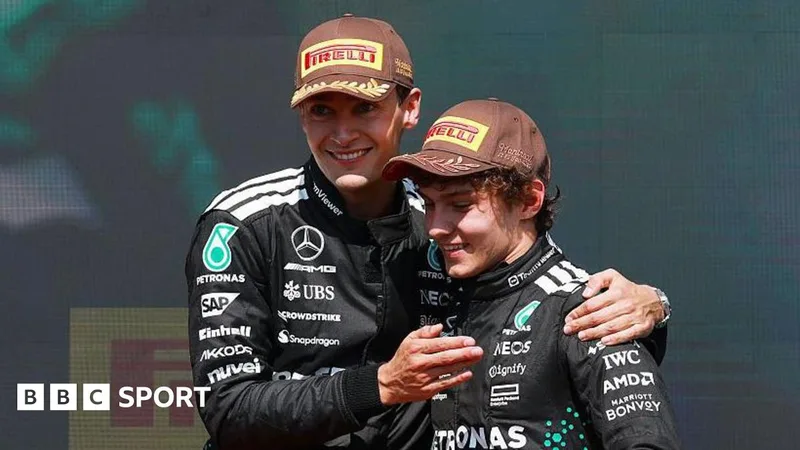
There is a particular quality to the way Mercedes approach a race weekend that separates them from everyone else on the grid. They build. Quietly, methodically, almost invisibly — and then, when it matters, they arrive. Friday afternoon at Albert Park was the first flicker of what that looks like in 2026.
Andrea Kimi Antonelli finished second in FP2, just 0.214 seconds behind Oscar Piastri’s session-topping McLaren. George Russell was third, 0.320 seconds back. After a morning session where both Mercedes drivers lurked in seventh and eighth, the transformation was striking.
The Afternoon Awakening
In FP1, Russell and Antonelli appeared to be running through the motions — tyre evaluation, systems checks, the unglamorous foundation work that separates a good weekend from a great one. “We didn’t have the smoothest first Friday of the season,” Russell admitted to F1.com. Antonelli was equally candid: “It was a difficult start to our day in FP1, where we had to focus predominantly on improving our battery deployment.” The W17 didn’t look slow, exactly, but it didn’t look like a pole contender either.
FP2 told a very different story. Russell’s first run on the soft compound immediately put him among the frontrunners — despite needing a new front wing fitted early in the session after Racing Bulls rookie Arvid Lindblad made contact with his car in the pit lane. When Antonelli followed with an even quicker lap, the Mercedes garage permitted themselves a quiet nod of satisfaction. The car had come alive.
What made the performance particularly noteworthy was the balance. Through Albert Park’s flowing middle sector — where aerodynamic efficiency and mechanical grip must work in concert — the Mercedes was arguably the most composed car on the circuit. Both drivers carried more speed through the fast left-right at turns nine and ten than anyone else on the timing screens.
Russell: The Quiet Confidence
Russell’s demeanour after FP2 carried the unmistakable air of a driver who knows his car is quick. Seventh to third between sessions is the kind of progression that comes from understanding, not luck. The 2026 regulations have clearly suited the Mercedes philosophy — their ground-effect concept appears to deliver consistent downforce without the ride-height sensitivity that plagued earlier generations.
At 28, Russell is entering his prime. He has the speed, the racecraft, and now, potentially, the car to challenge for the championship. P3 in FP2 may seem modest, but the manner in which it was achieved told a far more ambitious story.
Antonelli: Beyond the Supporting Role
If FP2 belonged to anyone at Mercedes, it was Antonelli. The 20-year-old Italian, in only his second full season, outpaced Russell by a tenth of a second. For a driver still building his understanding of F1’s unique demands, that is a remarkable statement.
Antonelli’s confidence through the high-speed sections was notable. He committed to corners with a trust in the car that sometimes takes years to develop. Whether this translates to qualifying and race pace remains to be seen, but the raw ingredients are undeniably there.
Setting the Stage
The contrast between Ferrari’s FP1 dominance and their FP2 decline placed Mercedes’ progression into sharp relief. While Charles Leclerc and Lewis Hamilton grappled with a car that appeared to lose its edge in warmer conditions, Mercedes found theirs.
Russell himself has historically excelled in cooler conditions — a characteristic that aligns perfectly with qualifying at Albert Park, where the late-afternoon shadows creep across the circuit as the session reaches its decisive moments.
The pieces were falling into place. FP2 was not the destination for Mercedes. It was the announcement that they had arrived.
RK — australiafootball.com
 Best Betting Sites
 Best Online Casinos
 Blackjack Sites
 Online Pokies
 Fast Payout Casinos
 PayID Casinos
 New Casinos 2026