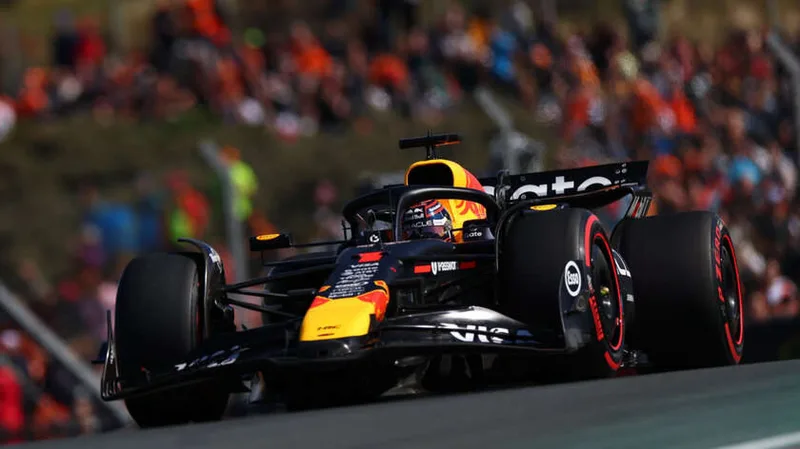
There is an Italian expression — chi va piano, va sano e va lontano. He who goes slowly, goes safely and goes far. Max Verstappen did not go slowly on Friday morning in Melbourne, finishing third in FP1 with a 1:20.789, but the Dutchman’s measured approach to this opening practice told you everything about where Red Bull Racing find themselves entering the 2026 era.
Half a second behind Charles Leclerc’s Ferrari at the top. Close enough to remain dangerous. Far enough away to suggest there is work still to do.
Verstappen’s Calculated Approach
Third in FP1 is neither cause for celebration nor concern for a four-time World Champion. Verstappen’s programme appeared deliberately conservative — long runs on the hard compound interspersed with the occasional push lap to calibrate the car’s single-lap potential. The 0.522-second gap to Leclerc will narrow. It always does with Verstappen.
What was more interesting was his body language in the garage. Animated conversations with his engineers, pointing at data on the screens, the intensity that defines everything this man does in a racing car. The RB22 is a new beast under these 2026 regulations, and even Verstappen is learning its limits.
“Pace wise, we are where I expected us to be. There is still a lot of work to do,” Verstappen told F1.com. Red Bull’s chief engineer Paul Monaghan added context: “Today we ran two cars with our own power unit for the first time at a race weekend.” That detail matters — this is an entirely new powertrain for the Milton Keynes team, and extracting performance from it will take time.
Norris: Seven Laps and Done
At the other end of the emotional spectrum, Lando Norris — the reigning World Champion carrying number 1 on his McLaren — completed just seven laps before the shutters came down. Classified 19th with a best time of 1:24.376, over four seconds off the pace.
McLaren remained characteristically guarded about the reasons. Mechanical precaution? Data anomaly? Strategic choice? The Woking team gave nothing away, but seven laps in FP1 of the season opener is not part of any ideal plan. It means Oscar Piastri’s P6 carries extra weight — he is McLaren’s sole data source from a meaningful FP1 programme.
The Rookies Who Stole Friday
Forget the established names for a moment. The true narrative of FP1 at Albert Park belonged to the young guns.
Isack Hadjar, the Franco-Algerian talent making his Grand Prix debut alongside Verstappen at Red Bull, finished fourth. Fourth. Three-tenths behind a four-time champion on his first competitive day — despite suffering a big lock-up and running across the grass mid-session. “For our first session of the season everything went well,” Hadjar said afterwards. The composure required to deliver that performance, at this level, in your first session — it is extraordinary.
And then there was Arvid Lindblad. The 18-year-old Racing Bulls driver, who only a year ago was racing in Formula 2, planted his car fifth on the timesheet. Ahead of Piastri, ahead of George Russell, ahead of Lewis Hamilton’s Ferrari team-mate Norris. An astonishing debut.
These two are not here to make up the numbers. They are here to race, and FP1 was their opening statement.
Looking Ahead to FP2
The afternoon session at 16:00 AEDT will reveal far more. Track temperatures rise, the rubber laid down in FP1 evolves the grip level, and teams transition from exploratory running to genuine performance assessment. For Red Bull, the question is simple: can Verstappen close that half-second to Ferrari?
For Norris and McLaren, FP2 becomes critical. Seven laps is not enough data to build a qualifying setup. The reigning champion needs seat time, and he needs it urgently.
For the rookies? They simply need to keep doing what they did this morning. The F1 paddock has noticed. Believe me.
RD — australiafootball.com
 Best Betting Sites
 Best Online Casinos
 Blackjack Sites
 Online Pokies
 Fast Payout Casinos
 PayID Casinos
 New Casinos 2026