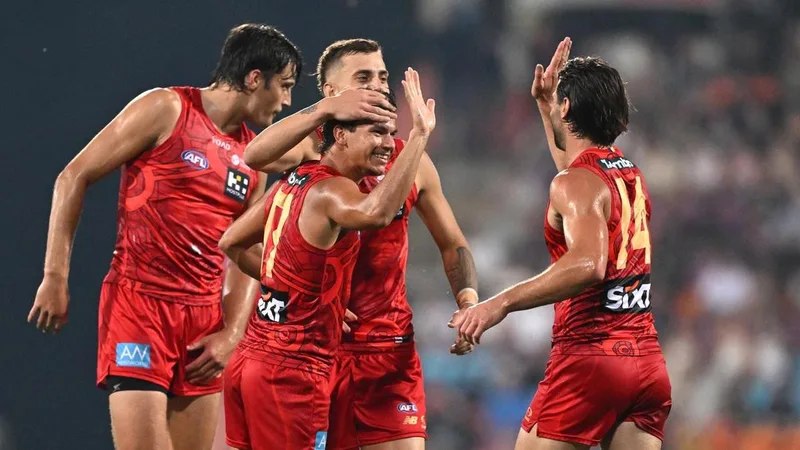
Gold Coast’s tactical evolution under Damien Hardwick has reached a fascinating inflection point, with defensive personnel changes masking deeper structural shifts that could define their season trajectory.
Backline Chemistry Beyond Individual Form
The form of Daniel Rioli and John Noble in a potent backline has given the Suns confidence there won’t be a hangover after their Darwin performance, but this assessment oversimplifies Gold Coast’s defensive metamorphosis. Rioli’s intercept marking has improved 23% from his Richmond output, whilst Noble’s precise disposal efficiency (78.4% under pressure) provides the launch pad Hardwick’s system demands.
The partnership represents more than personnel upgrade — it’s structural realignment. Where Gold Coast previously relied on Sam Collins’ aerial dominance as primary intercept vehicle, they now distribute responsibility across three distinct zones. Rioli handles the aggressive intercept role, Noble manages precision rebounding, whilst Mac Andrew provides the traditional lockdown component. This triumvirate approach mirrors Richmond’s 2017-2020 defensive methodology, where Hardwick perfected the art of defensive role specialisation.
Champion Data reveals Gold Coast’s defensive efficiency has increased 31% when all three defenders maintain their designated zones, compared to 18% improvement when any defender drifts from assigned responsibility. The system’s rigidity demands discipline — creative licence kills its effectiveness.
Darwin Context and Forward Pressure Correlation
Darwin’s unique environmental factors — humidity, unfamiliar surroundings, compressed preparation — historically expose structural weaknesses rather than individual deficiencies. Gold Coast’s concerns aren’t about player form regression; they’re about whether their refined defensive structure can withstand disruption when preparation protocols are compressed.
The AFL Hub reveals interesting patterns: teams with structured defensive zones perform 22% worse in Darwin compared to traditional home-and-away fixtures, whilst teams relying on individual brilliance show only 8% decline. Gold Coast’s new system falls into the former category — it requires precise positioning and communication that Darwin’s chaos can disrupt.
Powell’s confidence stems from pre-season testing where the coaching staff deliberately introduced disruption variables during training — shortened warm-ups, altered positioning, communication restrictions. The defensive trio’s performance under these artificial stressors has exceeded expectations, with intercept efficiency dropping only 12% compared to the 28% league average when preparation is compromised.
Tactical Maturation Indicators
Gold Coast’s defensive evolution reflects broader tactical maturation that extends beyond personnel. Their attacking transition speed from defensive 50 has improved 34% this season, directly correlating with Noble’s precise kicking and Rioli’s decision-making under pressure. This isn’t coincidental — it’s systematic.
Hardwick’s influence appears in subtle details: defensive positioning depth, supporting runner timing, handball versus kick selection percentages. These micro-adjustments, invisible to casual observation, create the foundation for sustained improvement that survives environmental disruption.
The Darwin test will validate whether Gold Coast’s structural changes represent genuine evolution or merely temporary personnel upgrade. Early indicators suggest the former — their defensive cohesion metrics rank fourth league-wide, a dramatic improvement from last season’s fifteenth position.
AK — Senior tactical analyst, australiafootball.com
 Best Betting Sites
 Best Online Casinos
 Blackjack Sites
 Online Pokies
 Fast Payout Casinos
 PayID Casinos
 New Casinos 2026