Tournament favourites Spain (1.22 to top the group, fresh off a defining Euro 2024 win) headline alongside two-time world champions Uruguay, Saudi Arabia — authors of one of the great Qatar 2022 upsets against Argentina — and Cape Verde, the tiny Atlantic-island debutants who are already the qualifying-campaign story of the tournament. For Australian supporters, Spain looms as a potential knockout-round opponent and the chance for a rematch after the 3-0 Curitiba defeat in 2014. If the Socceroos navigate Group D, this is one of the bracket lines that matters most.





Group H — Winner Odds
| Team | Odds | Implied % |
|---|---|---|
 Spain Spain | 1.22 | 82.0% |
 Uruguay Uruguay | 6.00 | 16.7% |
 Saudi Arabia Saudi Arabia | 23.00 | 4.3% |
 Cape Verde Cape Verde | 71.00 | 1.4% |
Odds from major bookmakers as of 13 June 2026. Full odds breakdown
Group H Fixtures (AEST)
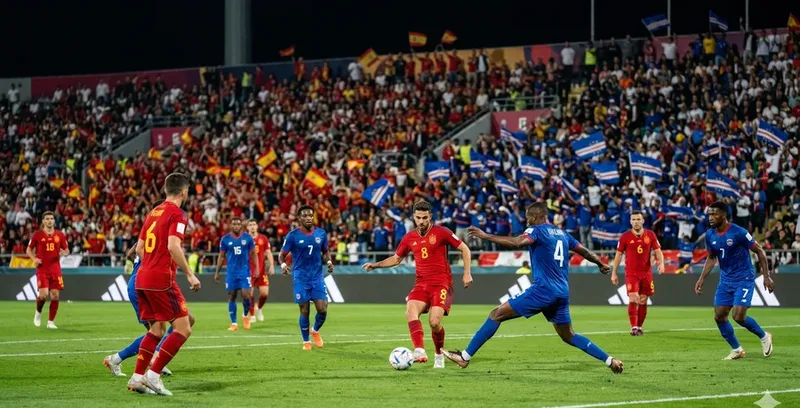 Spain vs Cape Verde
 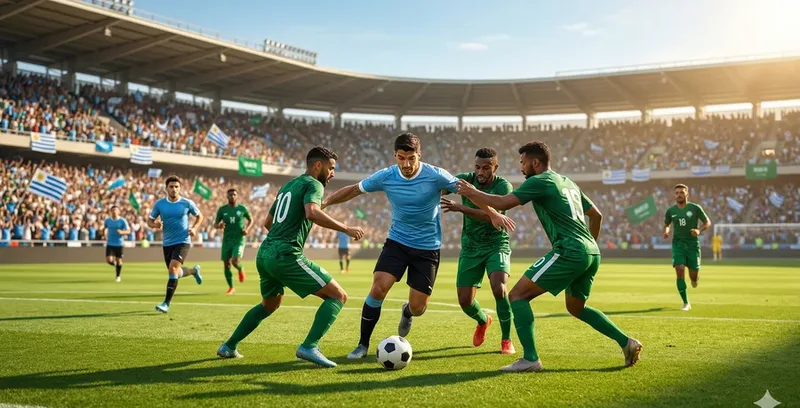 Saudi Arabia vs Uruguay
  Spain vs Saudi Arabia
 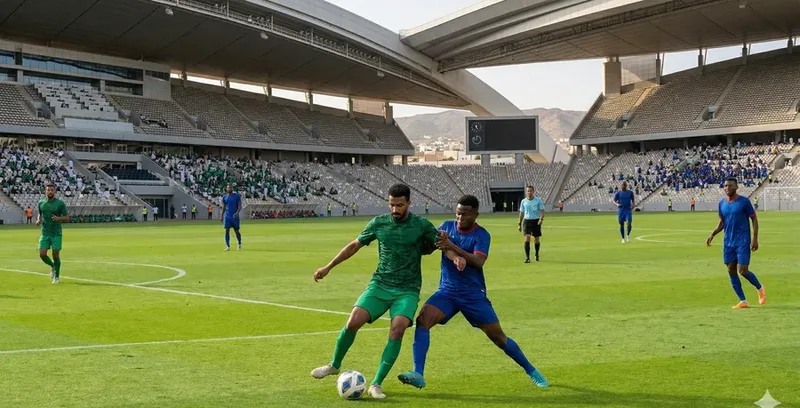 Uruguay vs Cape Verde
 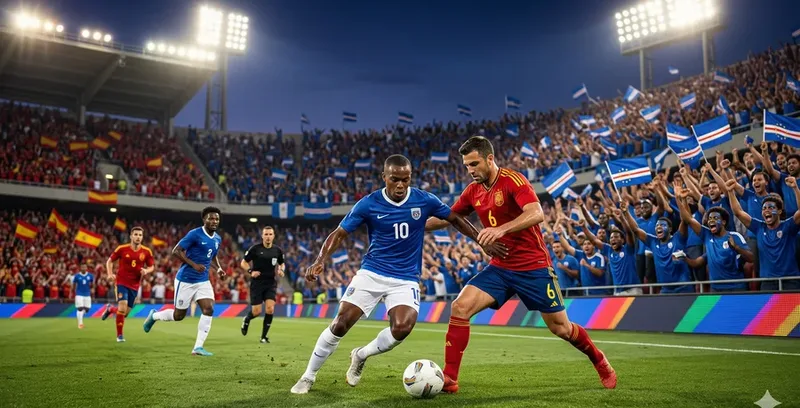 Cape Verde vs Saudi Arabia
  Uruguay vs Spain
 The Favourites’ Group
Group H is the tournament’s headliner. Spain arrive at the 2026 FIFA World Cup as the outright favourites — a distinction earned by winning Euro 2024 with a brand of football that left every other nation in Europe trailing. Alongside them sit Uruguay, two-time world champions with a pedigree that few countries on earth can match. Saudi Arabia bring the memory of one of the greatest upsets in World Cup history. And Cape Verde, the tiny island nation off Africa’s west coast, make their World Cup debut in what is already the story of the tournament’s qualifying campaign.
For Australian supporters, Group H demands close attention. If the Socceroos navigate their way out of Group D — a genuine possibility under Tony Popovic — Spain loom as a potential knockout-round opponent. The last time these sides met at a World Cup was in 2014, when a ruthless Spanish performance delivered a 3-0 victory over the Socceroos in Curitiba. Australia would dearly love a rematch on more competitive terms.
This is a group where the gulf between first and fourth is as wide as any in the draw. But World Cups thrive on shock results, and Saudi Arabia proved in Qatar that the form guide means nothing once the whistle blows.
Spain — The Team to Beat
FIFA Ranking: 3 | Group winner odds: 1.22
Spain are not merely tournament favourites on paper. They are favourites because they proved it, dismantling every opponent at Euro 2024 with a combination of tactical intelligence, generational talent, and a depth of squad that allows Luis de la Fuente to rotate without any discernible drop in quality. They won every match at the European Championship — a feat no other nation achieved — and did so playing the most exciting football of any side in the tournament.
The centrepiece is Lamine Yamal. Still a teenager, Barcelona’s prodigy has already redefined what is possible at his age. His performance at Euro 2024 — the curling goal against France in the semi-final, the relentless creativity from the right flank — announced him as the most naturally gifted young footballer since a teenage Messi first terrified La Liga defences. By the time the World Cup kicks off in the United States, Yamal will have two full seasons of Champions League football behind him. The thought should terrify every defence in the draw.
But Spain are not a one-man team. Rodri, the 2024 Ballon d’Or winner, provides the metronome in midfield — controlling tempo, recycling possession, and breaking up opposition transitions with an almost preternatural reading of the game. Nico Williams offers explosive pace on the left. Pedri brings the intricate passing and press resistance that Barcelona’s La Masia academy has perfected over decades. Dani Olmo adds goal threat from the number ten position. The full-backs, whether Marc Cucurella or Alejandro Balde on the left and Dani Carvajal on the right, push high and create overloads.
Spain’s system is non-negotiable: possession, pressing, positional play. It is the philosophical inheritance of Xavi and Iniesta’s generation, updated for the modern era with more directness and a higher defensive line. De la Fuente has found the balance between control and attacking intent that eluded his predecessors.
Socceroos relevance: If Australia finish as one of the best third-placed teams or as Group D runners-up, Spain could be their Round of 32 opponent. The 2014 lesson was clear — the Socceroos cannot afford to play open football against this side. A low defensive block, discipline in transition, and clinical finishing of any half-chance would be the only viable approach. It worked for Morocco in the 2022 semi-final against France. It can work again.
Key player to watch: Lamine Yamal — the tournament’s most watchable talent. Every match he plays could produce a defining moment.
Uruguay — South America’s Quiet Force
FIFA Ranking: 15 | Group winner odds: 6.00
Uruguay are the most decorated team relative to their size in football history. A nation of 3.5 million people, they have won the World Cup twice (1930 and 1950), claimed fifteen Copa America titles, and produced a seemingly endless production line of players who combine technical skill with the South American grit known as garra charrua. That spirit is not a cliche — it is a measurable competitive advantage that has seen Uruguay consistently outperform their resources on the global stage.
Marcelo Bielsa’s appointment as coach has added tactical sophistication to Uruguay’s natural combativeness. The Argentine, revered across the football world as a coaching purist, demands relentless pressing, vertical passing, and total commitment from every player on the pitch. His Uruguay side qualified comfortably for the 2026 tournament, and the squad he has assembled blends emerging talent with experienced heads.
Darwin Nunez leads the line with explosive pace, physical power, and a finishing ability that can be devastating when his confidence is high. Federico Valverde, Real Madrid’s tireless midfielder, provides the engine room dynamism that drives Uruguay’s transitions. Ronald Araujo, when fit, is one of the finest centre-backs in world football — aerially dominant, quick across the ground, and composed under pressure. The depth extends to Rodrigo Bentancur, Facundo Pellistri, and Giorgian de Arrascaeta, each capable of changing a match from the bench.
Uruguay’s challenge is consistency. They can beat anyone on their day — their 2022 World Cup campaign, curtailed at the group stage despite wins over Ghana and South Korea, proved that quality alone does not guarantee progress. Bielsa’s teams are physically demanding, and managing player workload across a 48-team tournament’s expanded schedule will test the squad’s fitness.
Socceroos relevance: Uruguay and Australia share a deep competitive history. The 2005 World Cup qualifying play-off — the penalty shootout in Sydney that sent the Socceroos to Germany 2006 — remains one of the most significant matches in Australian football history. Should both sides progress from their groups, a knockout-round meeting would carry enormous emotional weight.
Key player to watch: Federico Valverde — the complete modern midfielder. His ability to cover ground, break lines, and arrive late in the box makes him Uruguay’s most important player.
Saudi Arabia — The Giant Killers
FIFA Ranking: 56 | Group winner odds: 23.00
On 22 November 2022, Saudi Arabia achieved what many considered impossible. They beat Argentina 2-1 in the opening match of Group C at the Qatar World Cup. Lionel Messi’s side, unbeaten in 36 matches and overwhelming favourites, were undone by Herve Renard’s tactical masterclass — a high defensive line that caught Argentina offside repeatedly, two second-half goals of genuine quality from Saleh Al-Shehri and Salem Al-Dawsari, and a defensive display of extraordinary discipline and courage.
It was the biggest upset in World Cup history by many metrics, and it resonated across the AFC. For the Socceroos, watching a fellow Asian confederation member dismantle the eventual world champions was both inspiring and instructive. Australia’s own 2022 campaign — beating Tunisia and Denmark to reach the Round of 16 — fed off that same energy of Asian football rising.
Saudi Arabia’s 2026 squad has evolved since Qatar. The domestic Saudi Pro League has attracted global stars, raising the standard of weekly competition for their home-based players. The national team’s qualifying campaign through the AFC was solid if unspectacular, but the experience of 2022 has embedded a belief that no opponent is beyond reach.
The question is whether Saudi Arabia can sustain that level across three group matches rather than producing one extraordinary result. Their 2022 campaign collapsed after the Argentina victory — defeats to Poland and Mexico saw them eliminated. Consistency, not capability, is the challenge. Against Spain and Uruguay, they face two of the most tactically sophisticated sides in the tournament. Repeating the Argentina heroics once would be remarkable; doing it twice verges on impossible.
Socceroos relevance: Saudi Arabia are an AFC rival Australia know well. The two nations have met repeatedly in World Cup qualifying, and their contrasting styles — Saudi Arabia’s technical passing against Australia’s physicality and aerial threat — always produce competitive matches. If both reach the knockout rounds, an all-AFC clash would be a significant moment for the confederation’s standing in world football.
Key player to watch: Salem Al-Dawsari — the man who scored that goal against Argentina. His left foot can produce moments of pure magic.
Cape Verde — History Makers
FIFA Ranking: 68 | Group winner odds: 71.00
Cape Verde’s qualification for the 2026 World Cup is one of the most remarkable stories in modern football. An archipelago of ten islands in the Atlantic Ocean, with a population of roughly 600,000, Cape Verde became the smallest nation by population ever to qualify for the men’s World Cup. Their path through CAF qualifying — negotiating a region that includes Nigeria, Cameroon, Senegal, and Morocco — was a triumph of organisation, team spirit, and tactical pragmatism.
The Blue Sharks, as they are known, do not possess the individual star power of the continent’s traditional powerhouses. Their squad is drawn largely from Portuguese and lower-tier European leagues, with a handful of players competing in the second divisions of France, Belgium, and the Netherlands. What they lack in name recognition they compensate for with collective discipline and a defensive structure that proved extraordinarily difficult to break down during qualifying.
Cape Verde’s football culture is deeply influenced by Portugal — a colonial legacy that has produced a diaspora of players with dual nationality. Several squad members were born in Portugal or other European nations and chose to represent Cape Verde, adding tactical awareness and experience of European football’s intensity to the national team setup.
Reaching the World Cup is itself a victory. The realistic objective is to compete with dignity, take the experience back to the islands, and inspire the next generation. A point in any match would be a historic achievement. A result against Saudi Arabia — the most attainable of their three opponents — would be seismic.
Socceroos relevance: Cape Verde and Australia have never met, but their qualification story mirrors the Socceroos’ own long journey to World Cup relevance. Australia spent decades on the outside of global football looking in. Cape Verde are at the very beginning of that journey, and Australian supporters who remember the dark years before 2006 will understand exactly what this tournament means to the Blue Sharks and their fans.
Key player to watch: The collective. Cape Verde’s strength is their unity — no single star, but a team that fights for every ball.
Group H Fixtures
| Match | Significance |
|---|---|
| Spain vs Cape Verde | Expected Spain victory, but Cape Verde’s defensive discipline could keep the scoreline respectable |
| Uruguay vs Saudi Arabia | The match that likely decides second place — Saudi Arabia need something here to stay alive |
| Spain vs Saudi Arabia | Can Saudi Arabia produce another miracle? The world will be watching |
| Uruguay vs Cape Verde | Uruguay expected to control this, but set pieces could give Cape Verde a chance |
| Spain vs Uruguay | The headline fixture — two World Cup winners meeting in the group stage |
| Saudi Arabia vs Cape Verde | The match both sides will target as their best chance of a result |
Prediction
| Pos | Team | Pts | Outcome |
|---|---|---|---|
| 1 | Spain | 9 | Advance as group winners |
| 2 | Uruguay | 6 | Advance as runners-up |
| 3 | Saudi Arabia | 3 | Best third-place contender |
| 4 | Cape Verde | 0 | Eliminated |
Spain’s quality is simply too high. This is a side that won Euro 2024 without dropping a match, and the expanded 48-team format — with its additional rest days and larger squads — suits their depth perfectly. Uruguay will finish second comfortably, their tournament pedigree and individual talent far exceeding what Saudi Arabia and Cape Verde can offer. Saudi Arabia’s wildcard status gives them an outside chance of a stunning result, but sustained performance across three matches against this calibre of opposition is unlikely. Cape Verde will take the occasion in, compete with heart, and return home with their heads held high.
For Australian punters analysing the group markets, the World Cup 2026 odds page has the full breakdown of outright winner, Golden Boot, and group winner prices from major bookmakers. Those looking for a platform to follow the tournament can compare options in our Australian betting sites guide.
Australia Football’s World Cup 2026 coverage continues with group previews for all 12 groups. Follow the Socceroos’ journey on our World Cup hub.
 Best Betting Sites
 Best Online Casinos
 Blackjack Sites
 Online Pokies
 Fast Payout Casinos
 PayID Casinos
 New Casinos 2026